Why Gamers Treat Their Dice Like Family Heirlooms (And What That Actually Tells Us)
Let's be honest with each other for a second. You have a die — maybe a d20, maybe a full polyhedral set — that you refuse to let anyone else touch. It's probably scuffed. The ink in the numbers might be wearing off. You've owned it so long you can't even remember where it came from. And yet, if someone at your game table casually picked it up to roll initiative, you'd feel something close to a physical reaction.
You are not alone. Not even close.
Across tabletop gaming communities from Seattle coffee shops to Florida game stores, players are forming deep, almost inexplicable bonds with their dice. Some keep specific sets locked away for "important" sessions only. Others retire dice that roll "badly," placing them in little felt pouches like they're being given a dignified burial. A few folks swear their dice respond to how they're treated — warmed in the hand before rolling, spoken to softly, never left face-down on the table.
So what's actually going on here? Is this just quirky gamer culture, or does it tap into something genuinely human?
The Psychology Behind the Polyhedron
Dr. Stuart Brown, a researcher who has spent decades studying play behavior, has noted that humans naturally attach meaning to objects used during emotionally significant experiences. It's the same principle that makes your first baseball glove feel different from any glove you buy as an adult, even if the new one fits better.
For tabletop players, dice are the physical anchor of some of their most vivid shared experiences — the critical hit that saved the campaign, the natural 1 that wiped the party, the roll that crowned a years-long character arc. The die was there. It participated. And the brain, which is not always the rational machine we like to pretend it is, files that object under "significant."
"We're pattern-seeking creatures," explains one behavioral psychologist familiar with gaming communities. "When something good happens and a particular object is present, the brain draws a connection. It doesn't matter that the connection is statistically meaningless. Emotionally, it's very real."
This is the same mechanism behind athletes wearing the same unwashed socks during a winning streak, or musicians insisting on a specific pick before recording. The ritual isn't superstition in the dismissive sense — it's the brain building a framework for confidence and focus.
The Control Factor
Here's where it gets genuinely interesting. Tabletop gaming, at its core, is a beautiful exercise in surrendering control. You don't decide whether your rogue spots the hidden trap. The dice do. That randomness is part of the appeal — it creates genuine stakes, real tension, and stories nobody could have scripted.
But humans are also deeply uncomfortable with powerlessness. So we negotiate. We create rituals. We designate a "lucky" die and imagine that we've introduced some small variable we can influence. You can't control the roll, but you can control which die you roll with. You can warm it up. You can believe.
Longtime players often describe this tension with surprising self-awareness. "I know it's a random number generator made of resin," one D&D veteran from Chicago put it during a community forum discussion. "I know the math doesn't care about my feelings. But when I use my old d20, I feel more settled. I play better. Whether that's the die or just my head being in a better place — honestly, does it matter?"
That's a remarkably practical take. If the ritual produces a calmer, more focused player, the ritual is doing real work — even if the die itself is entirely neutral.
Collections, Identity, and the Dice We Choose to Show
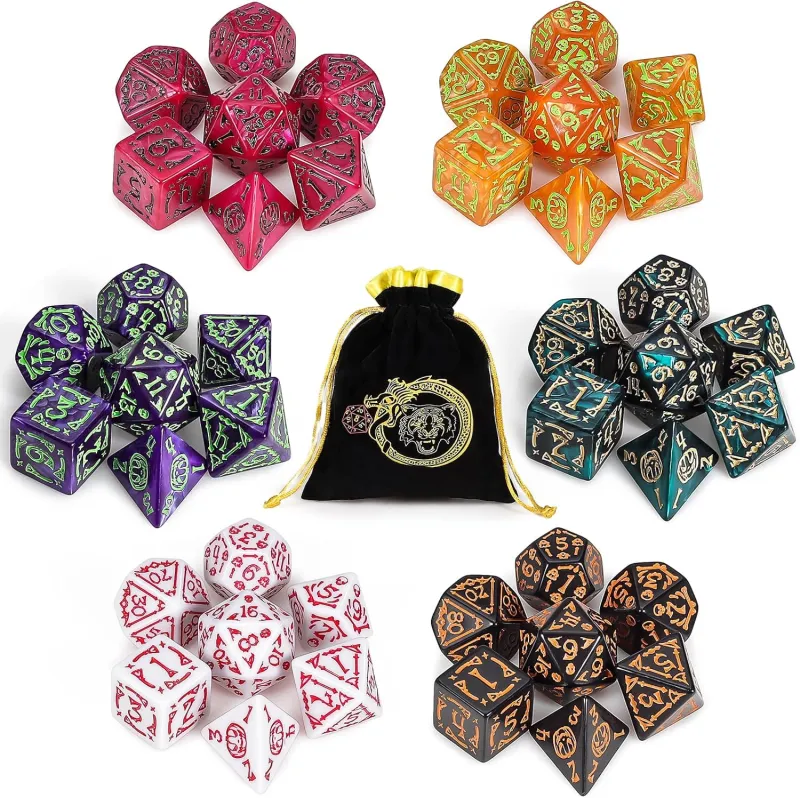
Walk into any game store in America and you'll find display cases full of artisan dice — handmade resin sets swirling with galaxies, metal dice that clang like tiny wrecking balls, glow-in-the-dark sets, dice embedded with flowers or tiny skulls. People spend serious money on these.
But this isn't just consumerism. The dice you choose to bring to a table say something about who you are as a player. The minimalist who shows up with a single worn wooden set. The maximalist with a tackle box sorted by color. The new player clutching a starter kit still in the packaging. Dice have become a form of self-expression in the tabletop world, a way of signaling your aesthetic, your history, your personality before you've even rolled for stats.
Collectors especially lean into this. Some folks own hundreds of sets — not because they need that many, but because each set represents something. A set bought at their first convention. A set gifted by a player who moved across the country. A set that "just feels right" for a specific character archetype.
This is nostalgia doing what nostalgia does best: turning objects into time machines.
When Attachment Becomes Anxiety
Of course, there's a flip side. For some players, the attachment tips past charming quirk into something that actually gets in the way of fun. The player who can't enjoy a session because they forgot their lucky set at home. The one who genuinely spirals after a bad rolling streak, convinced their dice are "cursed" and catastrophizing about future sessions. The collector who feels genuine distress if a die gets chipped.
Tabletop gaming communities are generally good at recognizing when hobby enthusiasm slides into something that needs a softer touch. Most veteran players will tell you the same thing: the dice aren't the game. The people around the table are the game. A bad roll from a "bad" die is still a story worth telling.
That said, there's no shame in having your rituals. Knock on the table. Blow on the die. Roll it in your palm three times. If it helps you feel present and engaged, you're not being irrational — you're being human.
What the Dice Actually Represent
At the end of the day, the attachment players form with their dice is really an attachment to everything the dice represent: the friends they've played with, the characters they've built, the hours spent around a table choosing imagination over screens. The die is a small, tangible piece of something that felt meaningful.
And in a world that sometimes feels like it's moving too fast to hold onto anything, having a little plastic polyhedron that carries that weight? That's not weird. That's kind of beautiful.
So go ahead. Keep your lucky d20. Warm it up before the big roll. Tell it you believe in it.
We won't judge you. We're doing the exact same thing.