Rolling for Leadership: The Surprising Reason Fortune 500 Companies Are Bringing D&D Into the Office

Picture this: a conference room in downtown Austin. The whiteboard is covered not in quarterly projections but in hand-drawn dungeon maps. The people around the table aren't pitching to investors — they're negotiating with a goblin merchant and arguing about whether the rogue should pick the lock or the paladin should just kick the door down. And everyone is having the best team meeting of their professional lives.
This is not a fever dream. This is Tuesday afternoon for a growing number of American companies that have quietly decided tabletop role-playing games are the best team-building tool money can buy.
The Problem With Traditional Team Building
Let's not be coy about the reputation of corporate team-building. Escape rooms are fine. Personality assessments produce polite nodding. Ropes courses generate mostly dread. And the classic trust fall has been a punchline for so long it practically has its own Wikipedia entry.
The fundamental issue isn't the activities themselves — it's that employees can see the machinery. When you know you're being evaluated, observed, or nudged toward a predetermined lesson, the experience calcifies. People perform instead of participate.
Tabletop RPGs sidestep this entirely. When you're playing a half-orc ranger trying to negotiate safe passage through a mountain pass, you are not thinking about your Q3 performance review. You are thinking about the mountain pass. And that's exactly when the interesting stuff happens.
What the Consulting Firms Figured Out First
A small but fast-growing ecosystem of consulting firms has built entire business models around this insight. Companies like Wheelhouse Workshop in New York and similar outfits across the country offer structured TTRPG experiences designed specifically for corporate clients. They're not just running D&D campaigns for fun (though the fun is very much part of it). They're designing scenarios that surface specific workplace dynamics: how teams communicate under pressure, how individuals handle unexpected failure, who steps up when the plan falls apart.
The pitch to corporate clients is straightforward: the skills required to succeed in a tabletop RPG — active listening, creative problem-solving, collaborative decision-making, graceful adaptation when things go sideways — are the same skills that make teams effective at work. The game is just a pressure-free environment to practice them.
"In a meeting, people protect themselves," one facilitator from a Chicago-based consulting group explained at a recent industry panel. "Nobody wants to float a bad idea in front of their VP. But at the game table, you have to try things. The scenario demands it. And when you try something and it works — or fails spectacularly — you learn something real about how you operate."
Case Studies Worth Rolling For
The companies adopting this approach span a surprisingly wide range of industries. A Seattle-based software firm integrated monthly TTRPG sessions into their onboarding process, specifically to help new engineers build relationships with team leads outside of formal hierarchies. The early results, according to their HR director, showed measurable improvement in cross-departmental communication within the first quarter.
A New York marketing agency used a custom-designed dice-driven scenario to run an innovation workshop for their creative team. Rather than a standard brainstorming session, participants played through a fictional problem — a kingdom running out of resources — and were forced to pitch solutions in character. The distance of fiction, the agency found, made people bolder. Ideas that might never survive a traditional pitch meeting got floated freely because the stakes were a fantasy kingdom, not a client budget.
On the larger end of the spectrum, several Fortune 500 companies — primarily in tech and finance — have begun piloting TTRPG-adjacent programs through executive education partnerships with universities. The programs are often framed as "scenario-based leadership training" rather than tabletop gaming, which tends to go over better with boards, but the mechanics are the same: dice, choices, consequences, and a facilitator watching how people behave when the rules of normal corporate life are suspended.
Why Dice Specifically? The Risk Mechanic
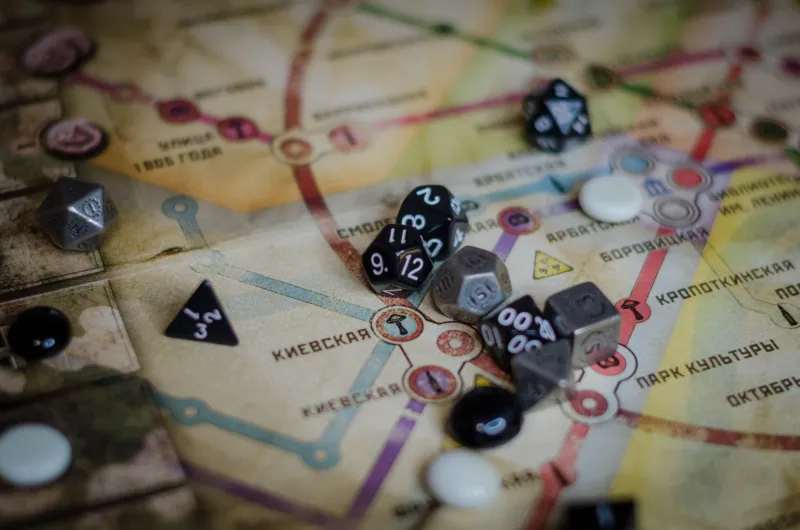
Here's something that doesn't get discussed enough in the broader conversation about TTRPGs in the workplace: the dice themselves are doing important work.
In a standard corporate environment, risk is abstract. We talk about it in percentages and projections. But when you're at a game table and you need to roll a 15 or higher to succeed at a critical action — and you watch that die tumble and land on a 7 — you experience risk viscerally. You feel the failure. You regroup. You figure out what to do next.
Behavioral researchers have noted that repeated exposure to low-stakes failure in game environments can meaningfully shift how people relate to failure in professional settings. The player who has rolled natural 1s and survived hilarious campaign disasters develops a different relationship with setbacks than someone who has only ever processed failure as an abstract concept in a post-mortem meeting.
Put simply: dice teach you that bad outcomes are survivable, that they're often funny in retrospect, and that the next roll is always coming.
The Skeptics Have a Point
Not everyone is convinced. Critics of the trend — and there are legitimate ones — point out that a two-hour D&D session does not fix systemic management problems, toxic workplace culture, or structural inequities that make teams dysfunctional in the first place. If leadership is disengaged or psychologically unsafe environments persist, no amount of dungeon-crawling changes that.
There's also a real question of accessibility and buy-in. Tabletop gaming still carries cultural baggage for some demographics, and employees who feel coerced into participating in an activity they find uncomfortable or unfamiliar aren't going to get much out of it. The best facilitators understand this and design entry points that don't require any prior gaming experience — but not every corporate program is run by the best facilitators.
The tool is only as good as the context it's deployed in.
Where This Is All Heading
Despite the valid caveats, the momentum here is real and probably not going anywhere. The tabletop gaming industry has been growing steadily for over a decade, and as the generation that grew up playing D&D moves into management and executive roles, the cultural resistance to bringing games into professional spaces is dropping fast.
Some observers predict that within five years, structured game-based leadership development will be a standard line item in corporate L&D budgets the way executive coaching is today. The consulting firms building this space are already scaling up. The academic research is beginning to catch up with the anecdotal evidence.
And somewhere in a conference room right now, a product manager is rolling a d20 to see if her character can talk her way past the dragon guarding the treasure vault — and learning, without quite realizing it, exactly how she'd handle the next difficult client negotiation.
The dice don't lie. Turns out, neither does the game.