Blessed Bones or Brain Games? The Real Truth About Lucky Dice
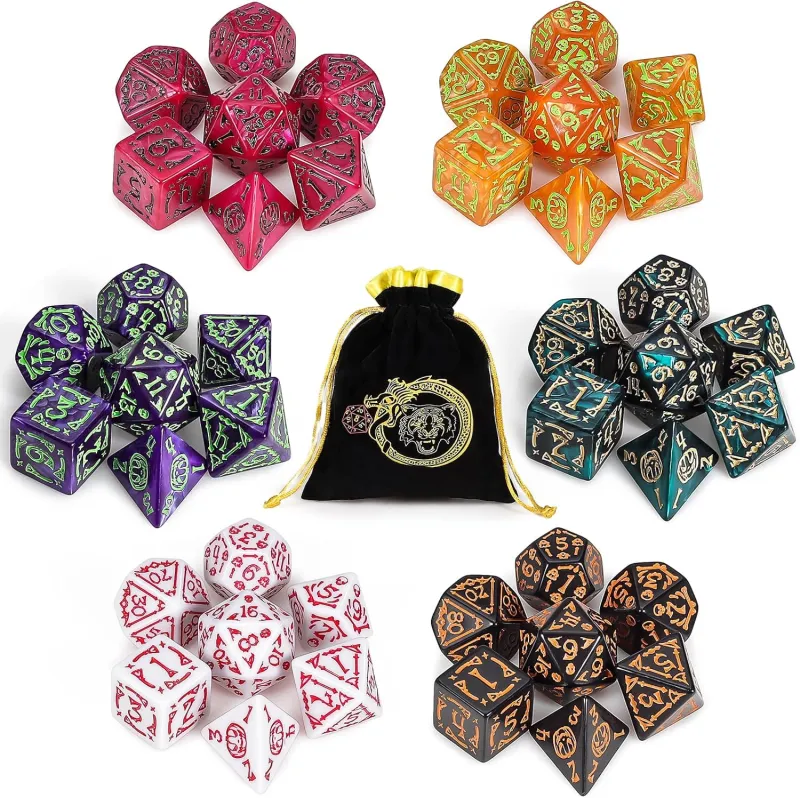
Photo: colorful polyhedral dice tabletop gaming ritual collection, via m.media-amazon.com
There's a specific kind of panic that hits a tabletop gamer when someone else picks up their dice. You know the look. Eyes go wide. Hand shoots out. A firm but slightly embarrassed "please don't touch those" escapes their lips before logic can intervene. If you've spent any time at a gaming table — or lurking in any of the major D&D subreddits — you've seen this play out a hundred times.
But why? Are lucky dice a real thing, or are we all just deeply committed to a collective delusion?
Spoiler: it's complicated. And honestly, kind of fascinating.
The Psychology of the Roll
Human beings are pattern-recognition machines. It's baked into our biology — we evolved to spot the tiger hiding in the tall grass, not to coolly assess independent probability events. So when your d20 crits three times in a row during a clutch combat encounter, your brain doesn't file that under "random variance." It files it under "this dice set is different."
Dr. Stuart Vyse, a behavioral psychologist and author of Believing in Magic: The Psychology of Superstition, has spent years studying why smart people develop irrational attachments to objects. "Superstitious behavior tends to spike in high-stakes, low-control situations," he's explained in interviews. "When outcomes feel uncertain and important, humans reach for ritual as a coping mechanism."
Sound familiar? Rolling for initiative before a boss fight is about as high-stakes and low-control as it gets — at least in the context of a Friday night game session.
The tabletop community has essentially built an entire subculture around this impulse. Dice jails (where "misbehaving" dice get quarantined between sessions), pre-roll rituals, lucky pouches, never letting other players touch your set — these aren't fringe behaviors. They're mainstream. Walk into any game store in America and you'll find someone who swears their translucent purple Chessex set rolls higher than their standard black ones.
Does Material Actually Matter?
Here's where things get genuinely interesting, because the answer isn't a flat "no."
Most consumer dice — your standard polyhedral sets from brands like Chessex, Kraken, or Norse Foundry — are made from acrylic resin. The manufacturing process involves pouring resin into molds, and the ink or pigment used to fill the number recesses can, in theory, create minor weight imbalances. The question is whether those imbalances are significant enough to matter in real-world rolling.
Gaming physicist and YouTube educator Daniel Fischer (who runs a small but dedicated channel on tabletop math) conducted a widely-shared experiment a few years back, rolling individual dice thousands of times and charting results. His conclusion? Mass-produced acrylic dice do show slight statistical biases, but the variance is so small — we're talking fractions of a percentage point — that it would take thousands of rolls before the effect became statistically meaningful in actual gameplay.
"You'd need to roll the same die about 10,000 times to reliably detect a bias that small," Fischer noted. "Nobody's doing that at a game table."
Metal dice, on the other hand, are a different story. Solid metal sets — typically zinc alloy or brass — are significantly heavier and manufactured with tighter tolerances. Many players swear by them for "fairness," and there's some logic there: denser, more uniform material distribution means less opportunity for internal air pockets or pigment-weight issues. But they also roll differently on hard surfaces and can damage gaming tables, which is why plenty of groups ban them.
Glass and gemstone dice (yes, those exist, and yes, they cost a small fortune) are generally considered the most physically balanced, but they're fragile and wildly impractical for regular play.
The Ritual Itself Might Be the Point
Here's the thing that often gets lost in the "lucky dice are fake" discourse: the ritual isn't necessarily about the dice.
Pre-performance rituals are well-documented performance enhancers across sports psychology. Athletes from Michael Jordan to Serena Williams have famously relied on pre-game routines, and research published in journals like Organizational Behavior and Human Decision Processes has shown that personal rituals can genuinely reduce anxiety and improve focus — regardless of whether they have any supernatural effect.
For tabletop players, the act of rolling your "lucky" dice, keeping them separate from the communal pile, or whispering an encouraging word before a critical throw might actually be doing something real — just not what you think. It's centering your focus. It's signaling to your brain that this moment matters. It's a tiny, personal performance of intention.
That's not nothing. That's actually pretty cool.
Loaded Dice: The Myth in Legitimate Gaming
One thing worth clearing up: truly "loaded" dice — deliberately weighted to produce specific outcomes — are essentially a non-issue in legitimate tabletop gaming communities. Unlike casino gambling, where the stakes justify elaborate cheating detection, most tabletop RPG sessions run on social trust and shared storytelling. Nobody's secretly weighted their dice to beat the DM.
Actual loaded dice are also surprisingly difficult to produce convincingly. Commercially available "trick" dice are obvious to anyone paying attention, and the tabletop community is extremely attentive to dice quality. Forums like r/DnD and BoardGameGeek have threads dedicated to identifying manufacturing defects — not cheating attempts.
The real "loaded dice" conversation in tabletop gaming is almost entirely about accidental bias from poor manufacturing, not intentional manipulation.
So, Are Your Lucky Dice Real?
Yes and no. Statistically, your beat-up set of Chessex Gemini dice isn't rolling higher because it likes you. The numbers don't care about your feelings.
But the confidence those dice give you? The focus that comes from your pre-roll ritual? The psychological comfort of a familiar object in a high-stakes moment? That stuff is real, and it has measurable effects on how you play.
Maybe that's enough. Maybe the magic was inside us all along.
(Your dice are still going in dice jail if they fumble on a nat 1 in the final boss fight, though. Some things are non-negotiable.)
Got a lucky dice ritual you swear by? Drop it in the comments — we're building a list of the community's wildest pre-roll superstitions. The more elaborate, the better.