What the Dice Are Really Telling You: A Casual Player's Guide to Probability

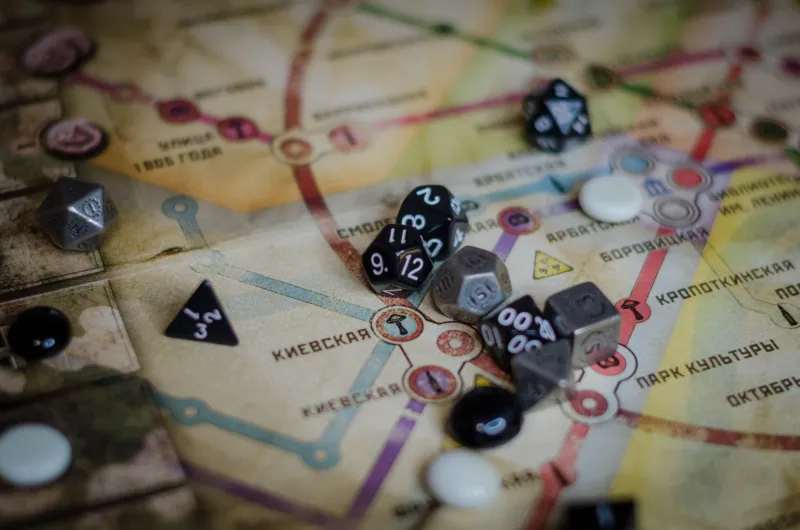
Photo by Photo by Nik Korba on Unsplash on Unsplash
You've been there. You need a six. The whole table is watching. You blow on the dice, whisper something embarrassing, and let it fly — and somehow, miraculously, it lands exactly where you needed it. Pure luck, right?
Well... kind of. But underneath that moment of tension, there's a whole layer of design working overtime to make sure that roll felt exactly as dramatic as it did. Game designers aren't just rolling the dice on your behalf — they're engineering your emotional experience using something most of us tuned out in high school: probability theory.
Don't worry. We're not going to make you do homework. But once you see the math hiding inside your favorite games, you'll never look at a dice pool the same way again.
The Bell Curve Is Your Game Master
Here's the foundational concept that shapes almost every dice-based game on your shelf: not all outcomes are created equal.
When you roll a single d6, every number from one to six has exactly the same chance of showing up — about 16.7%. That's what's called a flat distribution, and it's deliberately chaotic. Games that lean on single-die rolls tend to feel swingy and unpredictable, which can be great for high-stakes gambling mechanics or fast-moving filler games.
But when you roll two d6s and add them together — like in Catan, Monopoly, or a dozen other classics — something interesting happens. Suddenly, seven is roughly three times more likely to appear than two or twelve. Why? Because there are six different combinations that produce seven, but only one way to roll a two (both dice showing one). The result is a bell curve, where middle values cluster and extremes become rare.
Game designers absolutely love this. That clustering effect is what makes Catan's resource distribution feel tense rather than random. Settlements on a six or eight feel valuable because statistically, they are. You're not imagining it — the math is doing the emotional heavy lifting.
Expected Value: The Number Designers Obsess Over
Let's talk about expected value, which sounds intimidating but is actually just a fancy way of asking: on average, what should I get out of this roll?
In Yahtzee, for example, every decision you make — which dice to keep, which to reroll, when to settle for a small straight instead of gambling on a large one — can be evaluated through this lens. The expected value of rerolling four dice hoping for a Yahtzee is pretty low. The expected value of locking in a full house when you've already got three of a kind? Often higher than players realize.
Designers use expected value to balance games so no single strategy dominates. In games like King of Tokyo, the expected value of pushing for victory points versus staying aggressive with attacks creates a genuine strategic tension. Neither path is obviously correct — which is exactly the point. Good game design puts you at the intersection of multiple nearly-equal choices, where the dice become a tiebreaker rather than the whole story.
Why Low-Probability Moments Feel Like Movie Scenes
Here's where probability theory gets genuinely poetic. The reason your critical hit in D&D or your clutch roll in a tense Pandemic session feels cinematic isn't coincidence — it's design.
Game designers deliberately tune the odds so that extraordinary outcomes are rare enough to feel special but common enough to happen regularly over a full session. In Dungeons & Dragons fifth edition, rolling a natural 20 on a d20 is a 5% chance. Over the course of a four-hour game session where players roll dice dozens of times, it's almost certain someone at the table will hit that moment. The math practically guarantees a highlight reel.
This is sometimes called variance management. A game with too-low variance feels deterministic and boring — you always know roughly what's going to happen. Too-high variance and the game feels unfair, like outcomes are completely out of your hands. The sweet spot, where skilled designers operate, is a variance level that rewards good decisions while still leaving room for the unexpected.
Reading the Dice Pool Like a Map
Once you understand probability distributions, you can start using that knowledge as a genuine strategic tool — not just trivia.
In games with dice pools (think Shadowrun, Blades in the Dark, or Star Wars: Destiny), your job isn't to chase specific numbers. It's to understand how adding or removing dice shifts your overall probability landscape. Adding one die to a pool doesn't just give you one more chance — it changes the shape of what outcomes are likely. More dice generally means your results cluster closer to the average, reducing variance and making your rolls more predictable.
That's actually useful information. If you're in a situation where you need a high result to survive, a small dice pool with high variance might be your friend — even if the expected value is lower. Gamblers call this "going for broke." Tabletop designers call it a tension mechanic. Whatever you call it, knowing when to embrace volatility versus when to play it safe is a skill, and probability is the framework that makes it legible.
The Designer's Secret Handshake
The next time you're flipping through the rulebook of a new game, try to spot the probability architecture underneath. Ask yourself: is this a flat roll or a multi-die system? Does the game reward average outcomes or exceptional ones? Are the odds telling you something about what the designer wanted you to feel?
Games like Wingspan use dice in ways that deliberately create resource scarcity — the odds are tuned so you almost always get something useful, but rarely exactly what you wanted. That's not an accident. It's a carefully calibrated frustration loop designed to keep you engaged.
Understanding this stuff doesn't drain the fun out of gaming. If anything, it deepens your appreciation for the craft involved. Every great dice game is essentially a probability puzzle dressed up in theme and art and lore. The designers are whispering to you through the math — and now you know how to listen.
So next time you're at the table and the dice are doing something infuriating or miraculous, take a second to appreciate what's actually happening. The numbers aren't just random. They're telling a story — and someone designed that story specifically for you.