Rolling Through the Hard Stuff: How Therapists Are Using Dice to Help People Heal

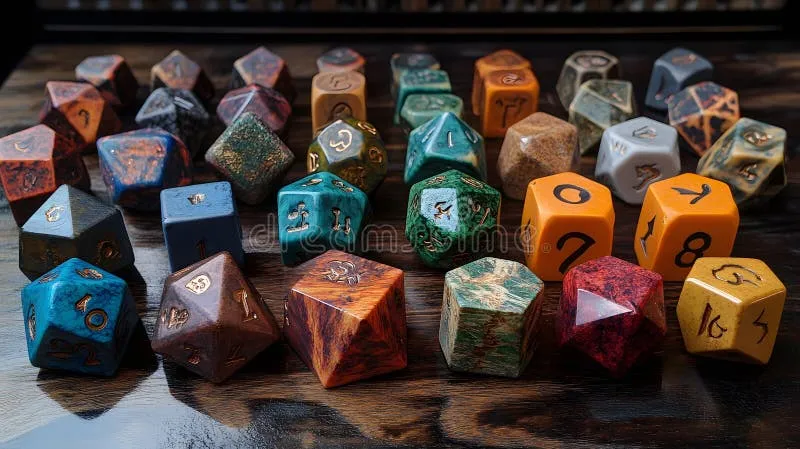
Photo: therapist office table with dice and notebook mental health counseling, via m.media-amazon.com
The first time Jess walked into a therapy session and saw a set of polyhedral dice sitting on the coffee table, she almost walked back out.
"I thought it was some kind of weird icebreaker," she recalls. "Like my therapist was going to make me play a game to avoid talking about real stuff."
She stayed. Twelve weeks later, she describes that session as one of the most emotionally significant experiences of her life — and the dice, she says, had everything to do with it.
Jess's story isn't unique anymore. Across the United States, a quiet but meaningful shift is happening in clinical settings. Therapists, counselors, and mental health professionals are incorporating dice-based games and role-playing mechanics into their practice — and the early results are turning heads in the field.
Why a d6 Might Be More Powerful Than It Looks
To understand why dice work in a therapeutic context, it helps to think about what they actually do. They introduce randomness. They shift agency. They give a person permission to become someone else for a moment — and sometimes, that's exactly the distance someone needs to start talking about the things that are hardest to say.
Dr. Sarah Wheelwright, a licensed clinical psychologist based in Portland, Oregon, has been integrating tabletop role-playing mechanics into her practice for the past four years. She works primarily with adolescents and young adults dealing with anxiety, depression, and social trauma.
"The structure of a dice-based game creates a container," she explains. "There are rules. There are outcomes you didn't choose. And there's a story you're building together. That combination does something really specific for people who feel out of control in their own lives — it gives them a framework where uncertainty is expected and manageable."
In other words, rolling a die and accepting the result — good or bad — is itself a form of practiced resilience. You didn't get to choose the number. You have to figure out what to do with it anyway. Sound familiar?
The Narrative Distance Effect
One of the most well-documented phenomena in psychology is the concept of narrative distancing — the idea that people can process difficult emotions more effectively when they're framed as happening to a character rather than to themselves. It's the same reason fairy tales have always carried moral weight, and why writing in the third person about a traumatic experience can sometimes feel easier than writing in the first.
Tabletop RPGs are essentially a structured, collaborative engine for narrative distancing. When a player describes what their character does in a dangerous situation, they're often drawing directly from their own emotional experience — fear, shame, the desire to run, the impulse to fight — but wrapped in the protective layer of fiction.
"I've had patients roleplay confrontations they've been unable to have in real life," says Marcus Tillman, a counselor in Atlanta who uses a modified version of a popular tabletop system in group therapy sessions for teenagers. "They'll say things through a character that they've never been able to say as themselves. And then we talk about it. The character becomes a way in."
The dice, in this model, add an element that pure narrative therapy doesn't have: consequence without control. A player might describe their character trying to stand up to an authority figure — and then roll poorly. Working through that failure, sitting with it, figuring out what comes next — that's not just good storytelling. For some patients, it's a direct rehearsal for life.
From the Couch to the Campaign
The formal name for this emerging field is "therapeutic tabletop role-playing game" therapy, or TTRPG therapy, and it's gaining traction faster than many practitioners expected. Organizations like the Bodhana Group, based in Pennsylvania, have been pioneering the use of tabletop games in therapeutic settings since 2013, training clinicians and publishing research on outcomes.
Their work, along with a growing body of academic interest, suggests that TTRPG-based interventions can be particularly effective for patients dealing with social anxiety, autism spectrum disorder, PTSD, and difficulties with emotional regulation. The shared social experience of gaming — the cooperation, the communication, the reading of other people's reactions — turns out to be excellent practice for exactly the kinds of interpersonal challenges many patients struggle with.
"Gaming is inherently social," says Dr. Wheelwright. "And it's low-stakes social in a way that real life often isn't. You can try something, fail, and the world doesn't end. That's incredibly valuable for someone who's been avoiding social situations because they're terrified of getting it wrong."
Not a Magic Spell — But Something Close
It's worth being clear about what TTRPG therapy isn't. It's not a replacement for traditional treatment. It's not appropriate for every patient or every condition. And rolling dice in a session isn't going to resolve deep psychological wounds on its own.
What clinicians are finding, though, is that it can dramatically lower the barrier to engagement — especially for patients who've had negative experiences with conventional talk therapy, or who struggle to access their emotions through direct conversation. For teenagers especially, showing up to talk about feelings can feel impossibly vulnerable. Showing up to play a game feels different, even when the game ends up being about exactly those same feelings.
Jess, the patient from the opening, eventually used her sessions to work through anxiety rooted in a difficult family dynamic. The dice never made that easy. But they made it possible.
"I could be brave as my character in ways I couldn't be as myself," she says. "And eventually, some of that bravery started to stick."
The Table as a Healing Space
For those of us who've spent years around gaming tables, there's something deeply resonant about this. We've always known that dice carry more than numbers — they carry stakes, stories, and the particular electricity of not knowing what comes next. That a growing number of therapists are finding that same energy useful in the work of healing feels less like a surprise and more like a long-overdue recognition.
The table, it turns out, has always been a place where people figure out who they are. Sometimes that happens in a dungeon. Sometimes it happens in a counselor's office. Either way, the dice are just waiting to be rolled.