Lost in Translation: Why Polyhedral Dice Feel Like a Foreign Language to New Players

Picture this: You've just convinced your friend group to try tabletop roleplaying for the first time. Everyone's pumped. Someone brought snacks. The books are spread across the table, and then — right around the moment somebody picks up a d4 and asks, "Wait, do I read the number at the top or the bottom?" — the energy quietly leaks out of the room.
It sounds trivial. But ask any game store employee or experienced dungeon master, and they'll tell you the same thing: dice literacy is one of the sneakiest obstacles standing between curious newcomers and the hobby they'd probably love. The problem isn't that people aren't smart enough to figure it out. It's that the tabletop world has spent decades assuming everyone already knows the rules of the rulebook about the rules.
The Alphabet Nobody Taught You
Standard dice notation — that shorthand system where "2d6+3" means roll two six-sided dice and add three — feels completely intuitive once you've internalized it. Before that? It's a cryptic string of characters that reads like a math problem written by someone who hates you.
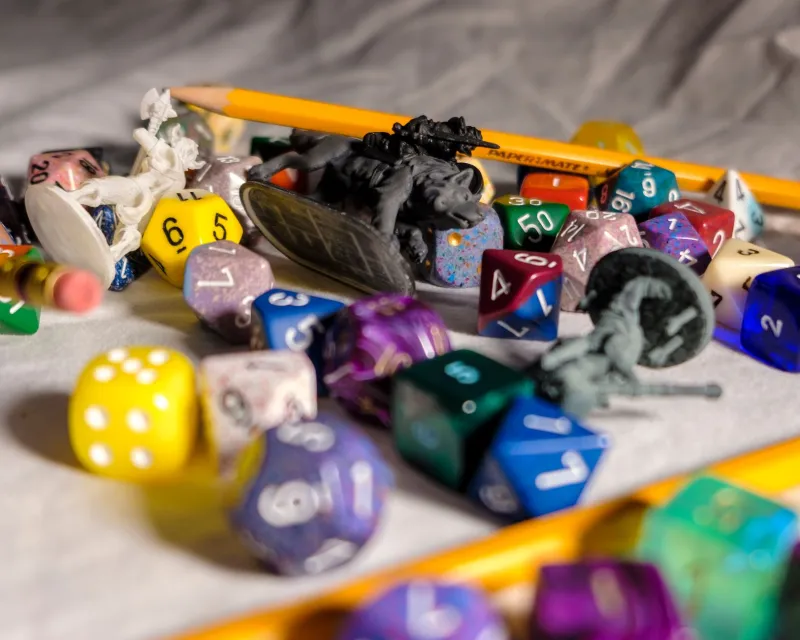
And that's just the notation. Then there's the physical reality of holding a d10, a d%, and a d20 in your hand and understanding which one does what, and when. The d4, bless its soul, doesn't even have a clear "top" face the way a standard cube does. The d10 is numbered 0 through 9, and the percentile version pairs with it in a way that requires a brief tutorial all on its own.
"We completely underestimate how much implicit knowledge experienced players carry around," says one indie game designer who runs accessibility-focused playtesting sessions. "Someone who's been playing since the nineties doesn't remember learning what a d20 is. It's just there in their brain. But for a newcomer, you're asking them to manage an entirely new symbolic language on top of learning rules, lore, and social dynamics all at once."
That cognitive load is real. Researchers who study learning and game design often refer to it as "onboarding friction" — the sum total of every small hurdle that stands between a player and the moment the game actually clicks. Dice literacy, it turns out, is a surprisingly significant chunk of that friction.
Who's Getting It Right
Not every game throws newcomers into the deep end. A handful of titles have made genuine strides in flattening that learning curve, and they're worth studying.
Kids on Bikes and similar narrative-focused RPGs lean heavily on plain-language explanations printed directly on character sheets, with labeled dice icons next to each stat. You don't need to already know what a d8 is — the sheet shows you a picture of one. Simple, obvious, effective.
Dungeons & Dragons' Starter Set has gone through multiple iterations specifically to address this issue. The current version includes a dice reference card and a "how to read this" section upfront, though veteran players sometimes joke that the tutorial is still written with the assumption that you've met dice before.
One-page RPGs — a booming micro-genre in the indie scene — often sidestep the problem entirely by limiting themselves to a single die type. Games like Lasers & Feelings use only a d6, which basically every American household already owns thanks to Monopoly. No notation required. Pick it up, roll it, compare it to a number. Done.
"The one-die approach is genuinely underrated as a teaching tool," notes another designer, who's spent the last few years developing beginner-friendly systems. "Once someone understands the core loop with a single die, introducing more types feels like an expansion of something familiar rather than a completely new concept."
The Store Counter Problem
Game shops across the country deal with this gap constantly. Walk into any well-staffed local game store on a Saturday and you'll likely find at least one employee patiently explaining to a new customer that no, you don't need to buy all the dice in the store to start playing, and yes, the funny pyramid one is actually legal.
Many stores have started building informal "dice 101" explainers into their new customer interactions, but it's a patchwork solution. There's no industry-wide standard for how to introduce someone to polyhedral dice, no universally adopted beginner's guide that ships inside every starter set, no QR code linking to a friendly explainer video.
This is where the tabletop community's DIY spirit both helps and hurts. YouTube is overflowing with "how to read dice" tutorials made by enthusiastic hobbyists, but the quality and approach vary wildly. A newcomer Googling their way through confusion might land on a thorough, welcoming guide — or they might end up watching a seventeen-minute deep dive into dice probability theory that sends them directly back to their PlayStation.
Teaching It Better
So what actually works when you're introducing someone to polyhedral dice for the first time? Experienced GMs and designers tend to agree on a few principles.
Start with the d6. Seriously. Everyone knows a d6. Build from familiarity before introducing the exotic stuff.
Use physical reference cards. Don't just say "grab the twenty-sided one." Put a labeled card on the table with pictures. It sounds condescending until the moment someone picks up a d12 when they needed a d20 and you realize it would have saved three minutes of confusion.
Name them out loud, repeatedly, without making it a lesson. Instead of stopping to explain notation, just say "roll the eight-sided die" while also saying "that's your d8" in the same breath. The association builds naturally.
Play a quick dice-only warmup game. Before the actual session starts, run a two-minute exercise where everyone rolls each die type once and reads the result aloud. It normalizes the objects before they carry any stakes.
Normalize asking questions. The number one reason newcomers stay confused is that they feel embarrassed to interrupt the table. Explicitly giving people permission to ask — and making it clear that no question is too basic — goes a long way.
The Bigger Picture
Dice literacy might sound like a small thing, but it sits at the front door of an entire hobby. Every person who bounces off a confusing rulebook or feels lost at a table during their first session is a potential lifelong gamer who just needed a slightly better on-ramp.
The tabletop industry has made real progress on accessibility in recent years — better representation, more inclusive design, alternative input methods for players with physical limitations. Dice legibility and notation clarity deserve a spot on that same list.
Because ultimately, the dice themselves aren't the barrier. The barrier is the assumption that everyone already knows what they're holding. Fix that assumption, and you open the door a whole lot wider.
And once someone rolls their first natural 20? Trust us — they'll never want to stop.