Oops, We Rolled a Classic: The Beautiful Accidents Behind Gaming's Most Iconic Dice
There's a certain kind of story that tabletop gamers love to tell around the table after the campaign wraps up. It's not always the story of the perfectly designed mechanic or the meticulously playtested ruleset. Sometimes, the best story is the one that starts with "nobody meant for this to happen."
Because here's the thing about dice culture that outsiders don't always get: some of the most celebrated pieces in the hobby exist entirely because something went wrong. A misprint here, a manufacturing quirk there, a color mix that wasn't supposed to make it past quality control — and suddenly, you've got a collectible that people are paying serious money for decades later.
The Misprint That Launched a Thousand Trades
If you've spent any real time in tabletop collecting circles, you've probably heard whispered reverence for "error dice" — sets that left the factory with a number stamped twice, a face rotated the wrong way, or ink that bled into colors that were never part of the original spec. In most manufacturing industries, these get tossed. In gaming, they get hoarded.
The phenomenon isn't entirely new. Early production runs of polyhedral dice in the 1970s and early 1980s were notoriously inconsistent. Molds were imperfect, numbering was sometimes hand-applied, and quality control wasn't exactly a top priority when a game company was operating out of a garage in Lake Geneva, Wisconsin. Those early chaotic production conditions meant that no two sets were quite alike — and players noticed.
"There's this d20 from a very early printing that has two 17s and no 3," says Marcus Teel, a collector based in Portland who has been accumulating error dice for about fifteen years. "Statistically, it's a terrible die. But the fact that it made it all the way through production and into someone's hands? That tells a story. I think about the person who rolled it for the first time and had no idea."
Teel's collection includes what he estimates are over 60 verified error dice, ranging from simple ink smudges to genuine numbering mistakes. He's careful to distinguish between intentional "variant" runs — which some companies have started producing on purpose to capitalize on collector interest — and the genuine accidents that he considers the real prize.
When the Factory Floor Becomes a Design Lab
Not every happy accident lives in a collector's display case. Some of them fundamentally changed how games were designed.
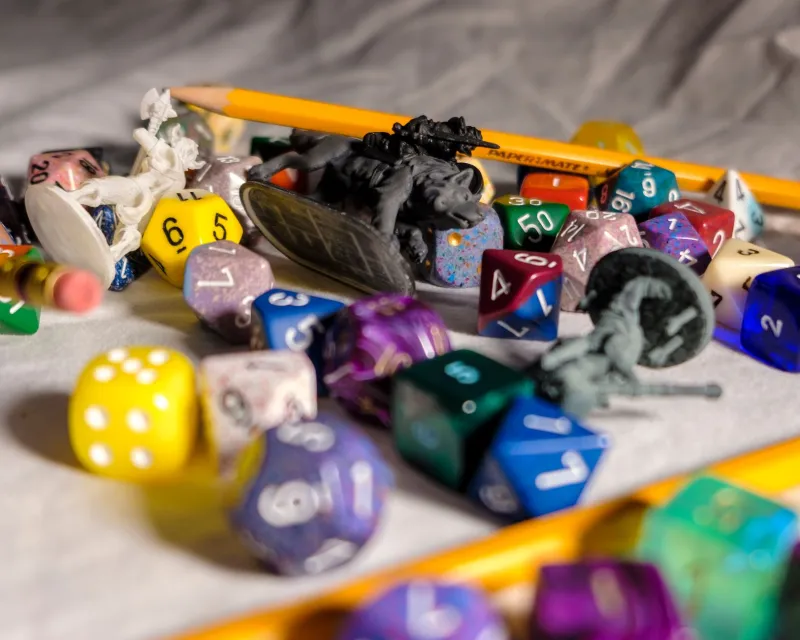
Consider the long history of translucent dice. The now-iconic "see-through" look that defines entire aesthetic categories of dice sets wasn't originally a deliberate design choice by a visionary art director. Early experiments with translucent materials were largely attempts to cut costs on pigment. The results were inconsistent — some batches came out beautifully clear, others cloudy, others with strange internal bubbles or swirls. But players loved them. The visual effect felt magical in a way that solid-color dice just didn't.
"There's a whole generation of gamers whose first 'special' dice were translucent purple or blue," says Jenna Hartwell, a tabletop game designer based in Austin who has spent years researching the material history of gaming components. "That aesthetic didn't come from a mood board. It came from someone looking at a batch that technically didn't meet the original spec and deciding it was actually kind of beautiful."
Hartwell points to this as an underappreciated dynamic in gaming history: the feedback loop between manufacturing imperfection and player desire. Players responded emotionally to dice that looked unusual. Manufacturers noticed. What started as a defect became a feature, and eventually an entire product category.
The Color That Wasn't Supposed to Exist
One of the more fascinating rabbit holes in this space involves specific color combinations that collectors now treat as grails — rare, highly desirable, and often completely unplanned.
In the world of resin dice (a category that exploded in popularity through the 2010s and into the 2020s, largely driven by independent artisan makers on platforms like Etsy and through Kickstarter campaigns), the chemistry of mixing pigments and inclusions can produce wildly unpredictable results. An artisan might be aiming for a deep ocean blue and end up with a teal-green that catches light in a completely different way. Or a gold flake inclusion might clump in one corner of a d12, creating an effect that looks almost like a tiny galaxy.
These "failed" batches often become the most sought-after pieces.
"I've had customers reach out years later asking if I can reproduce a specific set I made by accident," says one independent dice maker who asked to be identified only by her maker handle, CrimsonCastDice. "The honest answer is almost never. The whole point is that it happened because I got the ratio wrong or the temperature wasn't quite right. You can't really manufacture a happy accident twice."
That irreproducibility is part of what drives the market. In a hobby that increasingly offers mass-produced options at every price point, the one-of-a-kind mistake carries a premium that no amount of intentional design can fully replicate.
When Mistakes Become Mythology
There's also a more philosophical dimension to all of this that serious collectors tend to circle back to eventually. Dice, more than almost any other gaming component, are objects that players form genuine emotional attachments to. They're held, rolled, blamed, thanked, and sometimes retired with ceremony. An error or an accident doesn't diminish that relationship — for many players, it deepens it.
"A die with a flaw has a personality," Teel says. "It's not just a tool anymore. It has a history, even if you don't know exactly what that history is."
That sentiment connects to something broader about why tabletop gaming culture resonates the way it does in the United States right now. In an era of digital entertainment where everything is optimized, A/B tested, and algorithmically refined, there's something genuinely countercultural about celebrating imperfection. About sitting down with a weird, slightly lopsided piece of plastic that wasn't supposed to look the way it does, and rolling it anyway.
The Accidental Legacy
Game designers, collectors, and artisan makers all seem to agree on one thing: the accidents aren't going away, and honestly, nobody wants them to. The manufacturing processes have gotten more sophisticated, sure. But as long as humans are involved — mixing resins by hand, calibrating molds, making judgment calls on the factory floor — the happy accident remains a real possibility.
And somewhere out there, in a dice bag that's been through a hundred sessions, there's probably a die with a tiny imperfection that its owner has never even noticed. A slightly off number. A color that runs just a little too warm. A bubble caught in the resin like a frozen moment.
Somebody's future grail. Already rolling.