Can't Stop Rolling: The Strange Psychology Behind Our Off-Table Dice Obsession

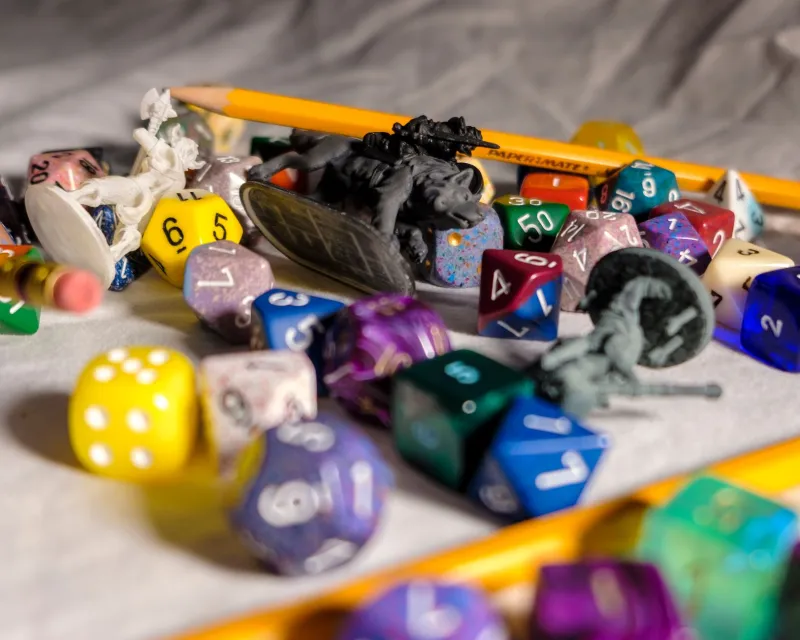
Ask any serious tabletop gamer to empty their pockets right now. Odds are, somewhere in there—between the ChapStick and the crumpled receipts—there's a die. Maybe a well-worn d20 with a lucky face worn smooth. Maybe a chunky metal d6 that clicks satisfyingly against your thumbnail. It's not there because a game is happening. It's there because it's always there.
This is the part of dice culture nobody really talks about: the rolling that happens when the game is long over.
The Ritual Nobody Admits To
Scroll through any major tabletop gaming subreddit or Discord server and you'll find threads that start the same way—someone sheepishly admitting they rolled a die before a job interview, or that they've been absentmindedly clicking a d6 through an entire Zoom call without noticing. The responses are always the same: same, same, oh thank god it's not just me.
This isn't fringe behavior. A 2023 informal poll conducted by a popular tabletop Discord community with over 40,000 members found that nearly 68% of respondents said they regularly handle dice outside of gameplay—and about a third of those admitted to rolling dice when facing real-world stress or decisions. That's not a quirk. That's a pattern.
So what's actually happening in our brains when we reach for a d20 instead of, say, a stress ball?
Dopamine, Uncertainty, and the Sweet Spot in Between
Dr. Pamela Hurst, a behavioral psychologist based in Chicago who has studied reward-seeking behavior in hobby communities, explains it in terms most gamers will immediately recognize. "The anticipation of an unknown outcome is one of the most reliable dopamine triggers we know of," she says. "Dice are essentially a portable uncertainty machine. Every time you roll, your brain gets a small hit of anticipatory excitement before the result even lands."
This is the same neurological loop that makes slot machines compelling—but with a crucial difference. Unlike gambling, rolling dice outside of a game carries no stakes. There's nothing to lose. Your brain still gets the chemical reward of uncertainty and resolution, but without the cortisol spike of actual risk. It's dopamine on training wheels, and honestly? That sounds kind of perfect.
Hurst calls this a "low-cost stimulation loop." The physical act of picking up a die, feeling its weight, throwing it, and watching it tumble satisfies multiple sensory inputs simultaneously—tactile, visual, auditory—while also delivering that mini-rush of randomness. For people who are anxious, overstimulated, or just plain bored, that loop can become a go-to self-regulation tool without them ever consciously deciding to use it that way.
Control, Chaos, and Why That Combo Is Irresistible
Here's where it gets philosophically interesting. Dice represent something genuinely paradoxical: they're an object you control (you hold it, you throw it, you decide when and how) that produces an outcome you cannot control. For a lot of people, that's not frustrating—it's deeply comforting.
"There's a subset of people who find pure randomness more relaxing than pure agency," explains Marcus Webb, a cognitive behavioral therapist in Austin who works with several clients who are avid gamers. "When you're overwhelmed by a decision, handing a sliver of it over to chance can actually reduce decision fatigue. The die doesn't judge. It doesn't have an agenda. It just rolls."
Webb notes that some of his clients have described rolling dice before difficult conversations or uncertain situations not as a superstition, but as a way of "loosening their grip" on outcomes they were too anxious to approach directly. "It's not that they're letting a die make their decisions," he clarifies. "It's more like the act of rolling reminds them that not everything is in their control—and that's okay."
For a culture that's spent decades learning to embrace randomness as a feature rather than a bug, that's a pretty elegant coping mechanism.
Fidget Culture Meets Fantasy
It's worth acknowledging that the broader fidget toy boom of the last decade created a cultural permission structure for this kind of behavior. Fidget spinners, pop-it toys, and worry stones all normalized the idea that hands-on sensory objects serve a legitimate mental function. Dice, in many ways, are the original fidget toy—they just come with decades of narrative baggage that makes them feel more meaningful than a plastic widget.
The tabletop gaming community has leaned into this hard. Dice manufacturers now openly market "fidget dice" and "stress sets"—smaller, smoother, or unusually weighted dice explicitly designed for handling rather than rolling in games. The market for premium metal dice has exploded in part because heavier dice feel more satisfying to manipulate. People aren't just buying dice to play games. They're buying dice to hold games.
When Does Quirky Become Concerning?
Fair question, and one worth asking honestly. Most behavioral psychologists draw a clear line between a soothing habit and a compulsion based on one simple metric: does it interfere with your daily functioning?
Rolling a die before bed because you like the sound? Harmless. Keeping a d6 in your pocket because it grounds you during anxiety? Totally reasonable. Refusing to make any significant life decision without consulting a die, or feeling genuine distress when you don't have one available? That's worth talking to someone about—not because dice are the problem, but because the underlying anxiety driving the behavior probably deserves some attention.
Webb is careful not to pathologize what is, for most people, a genuinely benign coping tool. "I'd rather a client reach for a die than doomscroll for forty minutes," he says with a laugh. "Context matters enormously. A habit that grounds you is very different from a habit that controls you."
The Community Knows Itself
What's striking, talking to tabletop communities about this, is how self-aware most gamers are about their rolling habits. They joke about it, they compare notes, they swap stories about the most absurd moments they've reached for dice outside of a game. There's no shame in it—if anything, it's a point of identity.
And maybe that's the most honest answer to the question of why we keep rolling when the game is over. Dice aren't just game pieces to the people who love them. They're tactile anchors to a hobby that's given them community, creativity, and a framework for navigating uncertainty. Every roll, even an aimless one on a Tuesday afternoon, is a small act of connection to all of that.
The game is never really over. It just moves to different tables.
Got a dice habit you want to confess? Drop it in the comments—we promise we've heard weirder.