When Dice Become Treasure: The Collectors Spending Thousands on Tiny Polyhedra
Walk into Marcus Delray's climate-controlled spare bedroom in Austin, Texas, and you'll immediately understand that something unusual is happening. Rows of acrylic display cases line every wall, each one backlit with soft LED strips. Inside, hundreds of dice sit arranged with the kind of precision you'd expect from a natural history museum. Some are antique ivory. Some are hand-poured resin with real flowers suspended inside. One set, sealed behind a locked case, reportedly cost him more than his first car.
"People think I'm joking when I tell them what I've spent," Delray says, laughing. "Then they see the collection and they stop laughing."
Delray isn't alone. Across the country, a passionate and surprisingly deep-pocketed community of dice collectors has turned what most gamers treat as functional accessories into serious collectibles. These aren't people hoarding dollar-bin grab bags from the local game shop. They're hunting limited production runs, commissioning custom artisan sets, and paying close attention to resale markets the way stock traders watch tickers.
What Actually Makes a Die Valuable?
Before you start side-eyeing your old Chessex sets, it helps to understand what separates a commodity die from a collectible one. The short answer: scarcity, craftsmanship, provenance, and condition. The long answer is considerably more complicated.
Limited production runs from boutique makers are often the entry point. Companies like Norse Foundry, Artisan Dice, and a wave of Kickstarter-born creators have built devoted followings by producing sets in small quantities—sometimes fewer than 500 sets worldwide. When those runs sell out, secondary market prices spike fast. A $60 Kickstarter set can flip for $200 to $400 within months if the maker has a strong reputation and the design resonates.
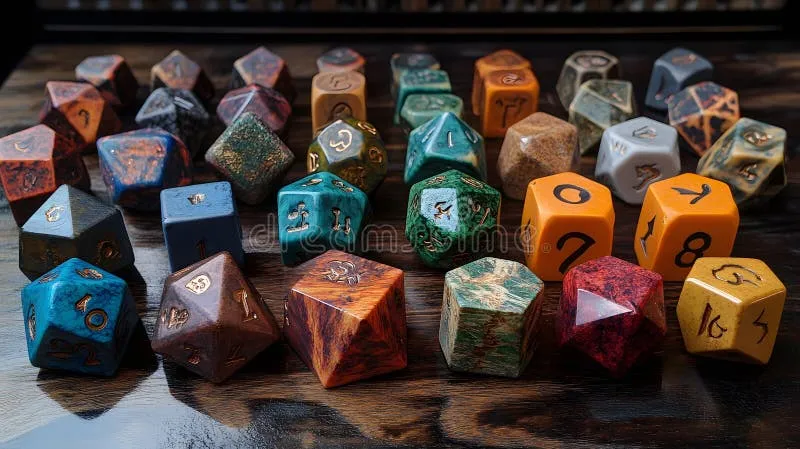
Material matters enormously. Standard plastic dice are the baseline. Step up to metal, and prices climb. Move into exotic woods, hand-turned stone, or genuine bone, and you're in a different category entirely. Artisan Dice, based out of Tennessee, has become famous for sourcing unusual hardwoods—things like ancient bog oak pulled from Scottish peat or locally harvested American burl—and turning them into dice on precision lathes. A single set can run $150 to $400 depending on the wood. Collectors snap them up anyway.
Then there are the truly rare historical pieces. Pre-20th century dice—especially those made from ivory, bone, or lead—occasionally surface through estate sales and antique dealers. Authenticating these requires real expertise. Collectors rely on a combination of visual inspection, material testing, and provenance documentation to verify age and origin. A well-documented set of Roman-era bone dice sold at a European auction house a few years back for the equivalent of several thousand dollars. Similar pieces pop up in the US market, though less frequently.
The Authentication Problem
Here's where things get complicated. As the collector market has grown, so has the incentive to fake or misrepresent dice. Someone listing a "rare 1970s TSR prototype" on an online marketplace might be telling the truth—or might be selling a $4 import with a creative backstory.
Serious collectors have developed informal but surprisingly rigorous methods for vetting purchases. Community forums like Reddit's dice-collecting communities and dedicated Discord servers function as crowdsourced authentication panels. Post a photo of a suspicious find and within hours you'll have a dozen experienced eyes picking apart the edge geometry, ink fill, font style, and material finish.
For higher-stakes purchases, some collectors go further. Hobbyist metallurgists have tested metal dice to verify alloy composition. Woodworkers can often identify species and grain patterns that confirm or contradict a seller's claims. One collector in the Pacific Northwest described commissioning a materials analysis on a set of claimed antique ivory dice before completing a four-figure purchase. The results confirmed the claim. He bought them.
"The community is really the first line of defense," says collector and part-time reseller Priya Nambiar from Chicago. "If you're about to spend real money, you post it, you ask questions, you wait. The people who get burned are the ones who rush."
The Psychology of the Hoard
Spend enough time in collector circles and a few recurring themes emerge. For many, the compulsion isn't purely financial. These aren't people flipping dice the way day traders flip penny stocks—though some do resell strategically. More often, the collection itself is the point.
Part of it is tactile. Dice, unlike most collectibles, beg to be handled. The weight of a solid brass d20, the smoothness of a hand-polished stone set, the way light plays through translucent resin—these are physical experiences that photography doesn't fully capture. Collectors talk about dice the way audiophiles talk about vinyl: there's something about the object itself that digital alternatives simply can't replicate.
Part of it is the hunt. Limited drops from popular makers sell out in minutes. Scoring a set requires monitoring social media, joining mailing lists, and sometimes setting alarms for odd hours. That friction creates genuine excitement around acquisition—and genuine pride in ownership.
And part of it, honestly, is community. The dice collecting world is small enough to feel personal. Makers know their repeat customers by name. Collectors trade sets, share finds, and argue passionately about which resins have the best clarity. For a lot of people, the collection is a passport into a specific social world they genuinely enjoy inhabiting.
What's It Actually Worth?
The honest answer is: whatever someone will pay. The secondary market for dice operates largely through eBay, Etsy, and dedicated Facebook groups, and prices can be wildly inconsistent. A set that fetches $300 in one sale might struggle to hit $150 six months later if the maker restocks or the hype cycle moves on.
That said, certain categories hold value reliably. Historical pieces with solid provenance appreciate steadily. Sets from makers who have since stopped producing—whether from burnout, business failure, or deliberate retirement—tend to command premiums. First-run editions from now-prominent makers often outperform later production.
Delray, who has been collecting seriously for about eight years, estimates his full collection would sell for somewhere between $25,000 and $40,000 if he liquidated everything tomorrow. He has no intention of doing that.
"People ask me if I'm going to sell when the market peaks," he says, picking up a hand-turned walnut d12 and rolling it absently across his palm. "I tell them I don't have a market. I have a collection. There's a difference."
For the dice obsessives of America, that distinction is everything. These aren't commodities waiting to be flipped. They're artifacts of a culture—small, weighted, numbered objects that carry the weight of countless stories, sessions, and rolls. That's not nothing. That might actually be worth something.