Rules as Written, Rules as Chaos: The House Rule Inventors Who Changed How We Play
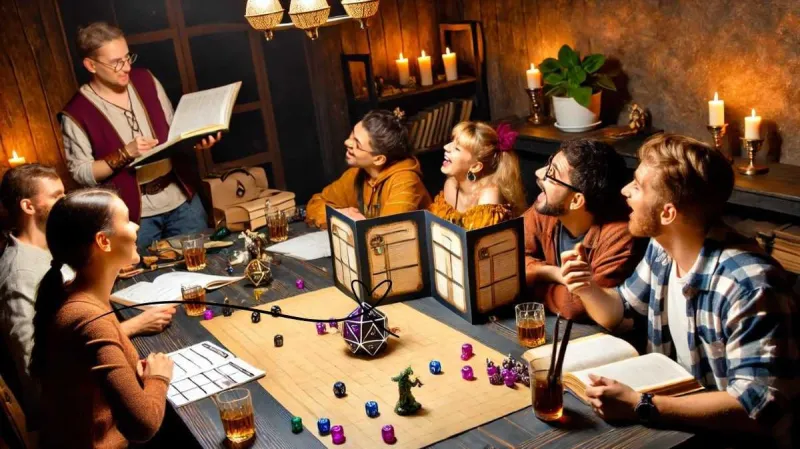
Photo: people playing dungeons and dragons tabletop RPG around kitchen table laughing, via weeklyquiz.net
Every great house rule starts the same way: something breaks.
Maybe the wizard's player has found a spell combo that trivializes every encounter. Maybe the death-saving throw rules feel punishing in a way that's draining the fun out of combat. Maybe someone at the table just looked up from the Player's Handbook, squinted, and said, "Wait, that can't be right."
And then somebody fixes it. Right there, at the table, with a ruling that feels more fair, more fun, or just more correct than whatever the book says. They write it on a sticky note, or just announce it to the group, and suddenly the game works again.
What happens next — when those fixes spread beyond one table and start shaping how thousands of people play — is one of the most underappreciated stories in all of tabletop gaming.
The Moment the Game Breaks (and Someone Gets Creative)
Jordan Vesper has been running D&D campaigns for about eight years, mostly for a rotating group of friends in the Seattle area. A few years back, she hit a wall with the action economy rules around healing. "We had a cleric who basically became a full-time ambulance," she says. "They weren't playing the game — they were just keeping everyone else alive. It wasn't fun for anyone, especially them."
Her fix was simple: healing spells cast on a willing, conscious ally could be delivered as a bonus action during that ally's turn rather than requiring the cleric's full action. "It sounds small, but it completely changed the dynamic. The cleric was back in the fight. They had decisions to make again."
She posted the rule modification to a D&D subreddit on a whim. Within a week, it had thousands of upvotes and hundreds of comments from DMs saying they were adopting it immediately. "I was genuinely shocked," she says. "I thought I was just solving a problem for my specific group."
She wasn't. She was solving a problem that existed at tables across the country, in games that had been quietly suffering the same frustration without a name for it.
Why Official Rules Leave Room — Sometimes Too Much
Tabletop RPG rulebooks are, by design, incomplete. That's not a criticism — it's almost a philosophical stance. Wizards of the Coast, Paizo, and other major publishers have long acknowledged that the rules are a framework, not a ceiling. The Dungeon Master's Guide literally tells DMs to change things that don't work for their table.
But that openness creates a gap, and players fill gaps. Sometimes the fills are clunky. Sometimes they're genius. And occasionally, they're so elegant that the original problem starts to feel embarrassing in retrospect — like the rulebook should have said this all along.
The "Flanking" debate is a good example. The optional flanking rule in 5th Edition D&D — which grants advantage when two allies are on opposite sides of an enemy — sounds intuitive but breaks down badly in practice, making advantage too easy to obtain and effectively devaluing half the game's tactical options. The homebrew community's response wasn't to abandon the concept but to rebuild it: flat +2 bonuses instead of advantage, or positional rules that only apply in specific terrain conditions. Multiple versions circulated online simultaneously, each representing a different table's answer to the same design tension.
"That's the thing about homebrew," says Derek Chu, a game designer and longtime DM based in Chicago who runs a popular YouTube channel focused on 5E mechanics. "It's not one solution. It's fifty solutions, and the community votes with their dice. The ones that stick are usually the ones that feel like they should've been in the book to begin with."
When House Rules Go Viral
The internet has completely transformed how homebrew spreads. What used to stay at one table — or at most, within a local gaming group or convention circle — now hits Reddit, Discord servers, and TikTok within hours of being conceived.
The "Healing Surge" mechanic is a notable case. Borrowed conceptually from 4th Edition D&D but reimagined for 5E by dozens of independent creators simultaneously, some version of a limited short-rest healing resource has been independently invented and posted so many times that it's impossible to credit a single origin. It spread because it addressed a real tension: the game's rest system can create awkward pacing at tables that don't have time for long sessions. The community didn't wait for an official fix. It made one.
Some house rules have become so ubiquitous that new players sometimes discover them before they encounter the official rules. "I've had players join my campaign who thought inspiration worked completely differently than it does in the books," says Vesper. "They'd learned the game from a streamer who used a house rule version, and that was just... the rule, as far as they were concerned."
This isn't a problem. It's actually kind of beautiful — evidence that the game is alive in the hands of its players, not just its publishers.
The Line Between Homebrew and Canon
Occasionally, the feedback loop closes completely. House rules become so widely adopted that they influence official errata, future editions, or supplemental material. The designers are playing the game too. They're in the same online spaces. They see what's resonating.
The "Flanking as +2" fix, multiple variants of the exhaustion system, and various interpretations of the concentration mechanic have all appeared in official or semi-official content after years of community experimentation. Whether that's direct influence or parallel evolution is usually impossible to say — but it signals something important: the players and the publishers are in a conversation, even when neither side fully acknowledges it.
Derek Chu puts it plainly: "The best game designers I know all started as players who were frustrated with something. Homebrew is just design with the filter removed. It's raw, it's sometimes messy, but it's honest. You're solving a real problem for real people at a real table."
Your Broken Game Is Someone Else's Blank Canvas
If you're running a campaign right now and something isn't working — a rule that creates more confusion than fun, a mechanic that one player has figured out how to abuse, a system that feels punishing in ways that don't serve the story — you're not alone, and you're not stuck.
You're at the beginning of something. Write the fix down. Try it. Tell people about it.
The best homebrew rules weren't created by designers with MFAs and playtesting budgets. They were created by people exactly like you, at tables exactly like yours, who hit a wall and decided to build a door instead.
Roll with it.