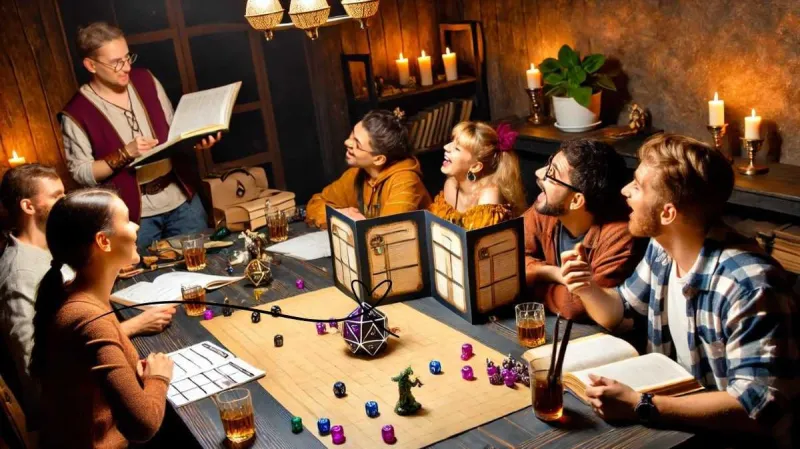
From Kitchen Table to Cash Flow: The Indie Creators Quietly Cashing In on the Dice Boom

Nobody Handed Them a Seat at the Table
Let's be honest about how the traditional gaming industry has worked for most of its history: if you didn't have a publisher, a distributor, and a warehouse full of capital, you didn't really have a business. You had a hobby with delusions of grandeur. The barrier to entry was steep enough that most aspiring creators just... gave up.
That story is getting rewritten fast.
Across the US, a growing wave of independent tabletop creators — designers, artists, dice manufacturers, and game developers — are building businesses that generate real revenue, support full-time salaries, and in some cases, clear seven figures annually. They're doing it without venture capital, without legacy publisher contracts, and without the safety net that corporate backing provides. What they do have is a direct line to their customers and a willingness to figure things out as they go.
The Math Behind the Hustle
Understanding how indie dice and tabletop businesses become profitable starts with understanding where the money actually goes. Production costs vary wildly depending on materials and manufacturing location. A set of resin dice, for example, might cost between $3 and $8 to produce when sourced from overseas manufacturers, while domestically produced metal sets can run $15 to $30 per unit before a single margin is calculated.
Jenna Calloway, who runs a small-batch dice studio out of Portland, Oregon, broke it down plainly in a conversation with D6 Online. "People see a $40 dice set and think I'm printing money. But once you account for materials, packaging, Etsy or Shopify fees, shipping, and the hours I put into design and quality control, my margins are tighter than most people assume."
So how does it become sustainable? Volume, community, and — crucially — platform selection.
Kickstarter Didn't Just Fund Projects. It Changed Everything.
It's hard to overstate how fundamentally crowdfunding platforms, and Kickstarter in particular, shifted the power dynamics of the gaming industry. Before crowdfunding, a great idea needed a great gatekeeper to say yes. Now, a great idea needs a great audience — and those are very different things.
Marcos Delgado launched his first dice campaign in 2019 from his apartment in Austin, Texas. He had $800 in savings, a prototype set, and a campaign page he built himself. Thirty days later, he'd raised over $47,000 from backers who wanted what he was making before it even existed.
"Kickstarter gave me proof of concept and upfront capital at the same time," Delgado told us. "I didn't have to convince a publisher. I just had to convince people who actually play games."
That model — validate first, produce second — has become the backbone of indie tabletop success. It eliminates the terrifying risk of manufacturing thousands of units with no guaranteed buyers. It also builds a community of invested customers who become your loudest advocates before the product ships.
Direct-to-Consumer Is the Real Competitive Advantage
Where traditional gaming companies sell through distributors and retail chains — each of which takes a cut — indie creators have increasingly moved to direct-to-consumer (DTC) models. Selling through their own websites, at conventions like Gen Con or PAX Unplugged, or through curated Etsy shops, these creators keep a significantly larger percentage of each sale.
The tradeoff is visibility. A game sitting on a shelf at Target reaches millions of potential buyers passively. A game sold through a creator's personal website needs active marketing to reach anyone at all.
This is where social media has become genuinely transformative. TikTok's dice-rolling community — sometimes called DiceTok — has sent small creators' products viral overnight. YouTube unboxing videos and Twitch tabletop streams have done the same. The creators who've figured out how to build audiences online aren't just selling games; they're building brands that function like media companies.
Tara Winslow, who runs a tabletop accessories brand out of Minneapolis, puts it this way: "I spend almost as much time on content as I do on product development. But that content is my storefront. It's how people find me, trust me, and decide to buy from me instead of a big brand."
Pricing Strategy: The Art of Not Underselling Yourself
One of the most common mistakes new indie creators make is underpricing their work in an attempt to compete with mass-market products. It's a losing game. A set of injection-molded plastic dice from a major manufacturer will always be cheaper than a hand-poured resin set from a solo artist — and that's actually fine.
The creators who succeed understand they're not competing on price. They're competing on story, craft, and connection. Buyers who seek out indie dice sets aren't looking for the cheapest option. They're looking for something that feels special, something with a narrative behind it.
Delgado now prices his sets between $55 and $120, positioning them explicitly as premium collectibles rather than utility gaming tools. "Once I stopped trying to compete with $15 dice from a big-box store, everything got easier," he said. "My customers aren't shopping for dice. They're shopping for something that means something to them."
The Ceiling Is Higher Than Anyone Expected
So what does the top of this market actually look like? Some of the most successful indie tabletop creators are pulling in revenues that would surprise even seasoned industry observers. Established Kickstarter campaigns for dice and tabletop games have raised millions of dollars — not from institutional investors, but from communities of enthusiastic players who'd rather fund a creator they love than wait for a corporation to decide what they deserve.
The creator economy in tabletop gaming is still maturing. Platforms will evolve, algorithms will shift, and production costs will fluctuate. But the underlying dynamic — passionate creators connecting directly with passionate consumers — isn't going anywhere.
If anything, the dice boom is just getting started.
What This Means for the Rest of Us
For players, the rise of indie tabletop businesses means more variety, more creativity, and more opportunities to support the kinds of games and creators that actually reflect your taste. For aspiring creators, it means the gatekeepers don't hold all the keys anymore.
And for the industry as a whole, it's a reminder that the most interesting things in gaming have rarely come from the top down. They've come from someone at a kitchen table, rolling dice, and deciding their idea was worth fighting for.