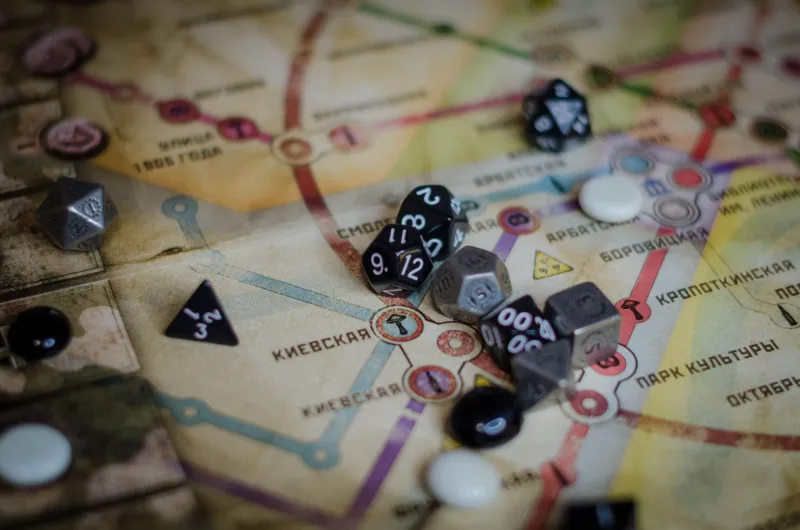
Suddenly Cold: The Gut-Punch Moment Your Favorite Die Decides to Ruin Your Life
You know the one. It lives in a special compartment of your dice bag, maybe wrapped in a little pouch or sitting on a tiny velvet throne in a display case you definitely didn't buy just for dice. It's rolled you out of death saves. It critted at exactly the right moment. It saved the party that one night in October when everything was on the line.
And then, one Wednesday evening, it just... stops.
Not literally. It still rolls. It still bounces across the table and settles into a number. But the numbers are wrong. They're always wrong. A three. A two. Another three. You pick it up, blow on it like that does anything, and roll again. A one.
Welcome to the Great Dice Betrayal — one of tabletop gaming's most universally shared and deeply irrational experiences.
It's Probably Just Math (But That Doesn't Help)
Let's get the uncomfortable part out of the way first. Statistically speaking, your d20 does not have feelings. It is not punishing you for skipping game night last month. It is not staging a character arc. It is a twenty-sided chunk of resin or plastic or acrylic, and every single roll is an independent event with an equal probability distribution.
That's the boring answer, and it's almost certainly the correct one.
But here's the thing about probability that even mathematically literate players tend to forget at the table: variance is brutal in short runs. A fair die can absolutely deliver six rolls under five in a row. That's not evidence of tampering or supernatural grudges — it's just what random distributions actually look like when you zoom in close enough. We're pattern-seeking creatures living in a universe that doesn't always feel the need to cooperate with our narrative expectations.
Dr. Ravi Sharma, a behavioral psychology researcher who has written casually about gaming cognition, puts it plainly: "Confirmation bias is doing a lot of heavy lifting in these situations. Players remember the dramatic failures far more vividly than the routine successes. The die that 'betrayed' them probably had an unremarkable week statistically, but the failures landed at moments of high emotional stakes."
In other words, your die didn't go cold. Your memory of the die went warm — and now reality feels like a betrayal by comparison.
The Veteran GM Perspective: They've Seen This a Thousand Times
Ask any game master who's been running campaigns for more than a few years, and they'll have stories. Not just one. A whole anthology.
Marco T., a GM based in Austin who's been running games since the early 2000s, describes what he calls "the funeral roll" — the moment a player's longtime lucky die produces a catastrophic failure at the worst possible narrative moment. "I've watched grown adults physically set a die aside and refuse to touch it for the rest of the session," he says. "One player literally put hers in a separate bag and said it needed to 'think about what it did.' She wasn't entirely joking."
That kind of anthropomorphizing isn't unique to gaming — humans project personality onto cars, plants, and appliances all the time. But dice have something those objects don't: they make decisions that affect outcomes we care about. That's a potent combination for emotional attachment.
Janice W., a GM in Portland who runs multiple ongoing campaigns, has started actually tracking this phenomenon at her table. "I started writing down when players blamed their dice versus when they praised them," she says. "The blame events happen after consecutive bad rolls in high-stakes moments. The praise events happen after a single good roll at a dramatic moment. The die is just a mirror for how the session is going emotionally."
The Character Arc We Didn't Ask For
What's genuinely fascinating about the Dice Betrayal phenomenon is how naturally players reach for narrative to explain it. The die isn't malfunctioning — it's evolving. It's going through something. It needs to be benched so it can "come back hungry."
This is storytelling brain doing what storytelling brain does best: making meaning out of chaos.
And honestly? That instinct is part of what makes tabletop gaming so sticky as a hobby. The same imaginative muscle that builds entire worlds around a rulebook and some polyhedral plastic is the one that decides a d20 has a personality, a mood, and a redemption arc waiting to happen.
Some players lean all the way into it. Reddit threads about dice betrayal are a goldmine of elaborate lore — people who've "retired" dice to a box of shame, players who've instituted formal dice trials at the table, GMs who've started writing dice behavior into session recaps as running jokes. There's a whole community ritual built around the emotional relationship between player and die.
So What Do You Actually Do?
If you're mid-campaign and your go-to die has apparently decided to take a personal day, here are a few approaches that won't involve a statistics lecture from your GM:
Rotate your dice deliberately. Some players swear by using different dice for different situations rather than relying on a single lucky piece. Spreading the emotional investment around makes any single betrayal feel less catastrophic.
Give the die a dramatic rest. Yes, it's irrational. Do it anyway. Benching a die for a session and coming back to it fresh can reset your emotional relationship with it — even if the die itself is completely unchanged.
Track your actual rolls for a few sessions. Nothing deflates the betrayal narrative faster than real data. You might discover your die is performing just fine and your memory is doing the heavy lifting.
Lean into the story. If your table has the right energy, the struggling die becomes a running bit. The dice gods are fickle. Your character is being tested. This is the part of the movie where things get hard before they get good.
The Real Reason This Hits Different
At its core, the Dice Betrayal is about vulnerability. When you sit down at a table — or log into a virtual tabletop — and invest real emotional energy into a character and a story, you're handing some of your narrative fate over to a random number generator. That's the deal. That's the game.
Most of the time, the randomness feels fair. Sometimes it feels generous. And occasionally, it feels like the universe is specifically, personally, and enthusiastically working against you.
Your lucky die didn't betray you. But the feeling that it did? That's proof you're actually playing the game — all the way in, emotionally committed, caring enough about the outcome to feel the sting when the numbers go sideways.
The die is just a die. The meaning is entirely yours.
And honestly, that's the most tabletop gaming thing there is.